Freight Document Agent
Reads consignment notes and customs papers into your system with a citation for every field, and stops on the ones it cannot support.
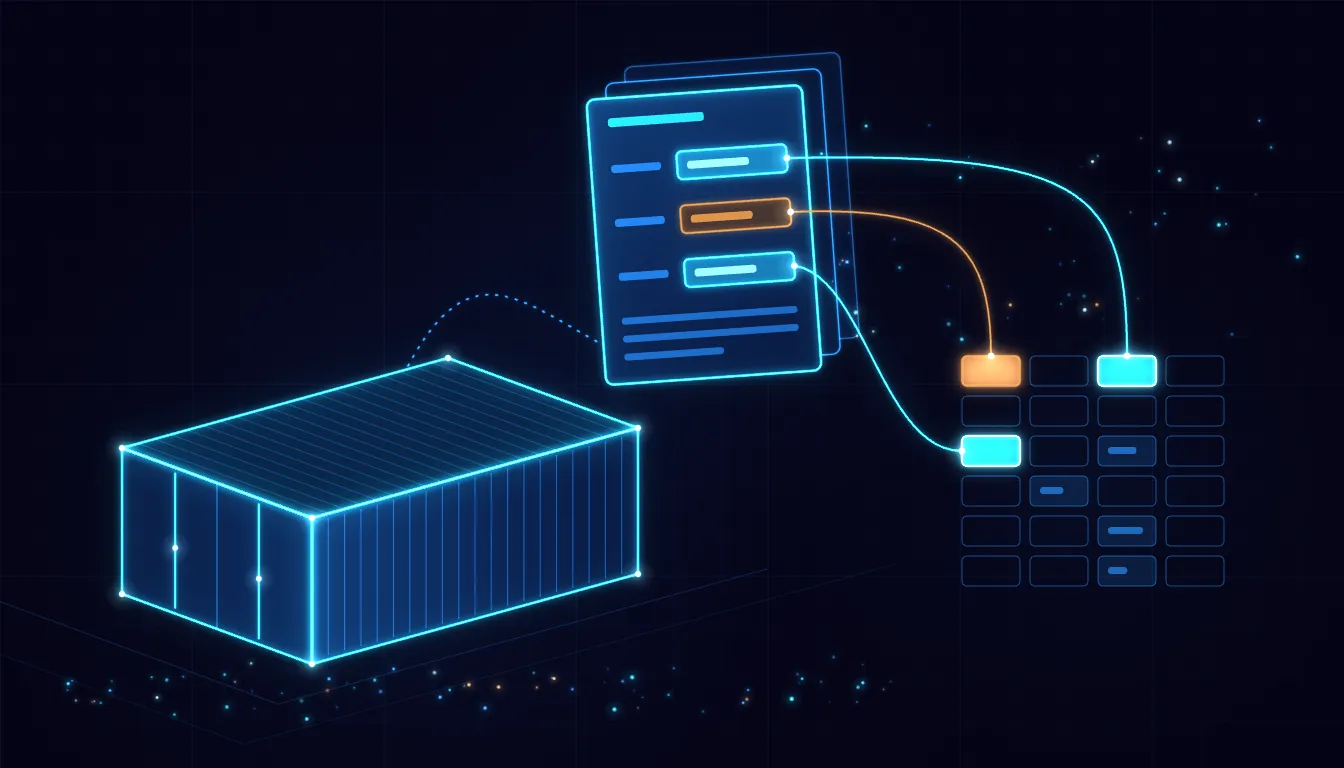
How it will work
Documents arrive
Consignment notes, customs papers and the other documents that travel with a shipment come in by email or as scans.
Every field gets a citation
Sender, receiver, goods, weights, references: each value is read with a pointer to the place on the page it came from.
It stops where it cannot support a field
A field it cannot read, or cannot back with the page, is left empty and sent to a person. It does not fill in a likely value.
The rest goes into your system
Supported fields are written to your transport or warehouse system through steps you approved, with the citation kept.
Methodology reference
The published method this build is based on, and what it did in production.
C.H. Robinson uses generative AI to read incoming shipping email and carry out the tasks a person would, taking more than 10,000 email transactions a day off manual handling.
Generative AI on freight email · as reported by C.H. Robinson ↗
Referenced for methodology only. AimRank is not affiliated with, endorsed by, or a customer of these companies; each links to its own public source. Sources last checked between September and November 2026.
The Four Guarantees™ - this build
The scaffold wires all four in. The PoC proves them on your data, as of that day. Only Implementation keeps them true over time: watched, drift-checked, with recourse as the Build page defines it.
Measured value
Planned gate, frozen before the first run, on your own past documents: how often a field is read correctly, and how often it stops when it should. No figure exists yet.
Defensible
Every field keeps its citation, and every document, field and hand-off will be written to a tamper-evident log.
Self-improving
Each correction becomes a test case, and a document layout it has not seen before is flagged the first time it appears.
Yours & everywhere
Planned to run in your cloud with full source handover, and an MCP endpoint so your own agents can read the fields and their citations.
Where it stands - honestly
Reference buyer: a freight forwarder or carrier whose staff retype consignment notes and customs papers into a transport system. Illustrative, not a measured case.
Three ways to own it
| Tier | What you get | Price | |
|---|---|---|---|
| Scaffolding ★ | Planned scope of the repo: reading of consignment notes and customs papers with a citation per field, the stop-and-ask path, the evaluation harness with its gate, audit log, MCP server. | €590 | |
| PoC ★★RECOMMENDED | Planned: run on an export of your own past documents, with field accuracy and the stop rate measured against what your staff entered. | scoped once the product is built | |
| Implementation ★★★ | Planned: connected to your transport or warehouse system through the steps you approve, the review queue live, monitoring, a monthly report of fields read and fields sent to a person. | Customquoted after the PoC, with monthly assurance |
★ = engagement depth. PoC is the recommended path: quality proven on your data before production money. It runs on a static export of your data, with no live connection to your systems. The PoC carries no performance guarantee by design; the agreed number (conservative) attaches at Implementation, informed by the PoC report.
What we don't promise
Ready to see your own number?
Request the build: within 48h you get a personal reply with the value sized to your volume.
No commitment · reply within 48h · your data stays in the EU